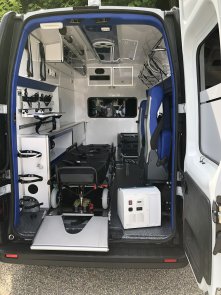
Ambulance transport is recommended when a person’s condition requires a specific means of transport. Depending on the patient’s state of health, their level of independence and the urgency of the situation, the doctor determines the most appropriate form of medical transport. Today, we take a look at ambulances.
In the event of an emergency, when dialling 15 (SAMU) or 112 (the European emergency number), the patient does not choose the ambulance service. An ambulance is dispatched as a matter of urgency by the emergency services. However, in the case of non-emergency transport, the patient is free to choose the ambulance service themselves.
Ambulance transport for sick or injured people is recommended in certain situations:
• Transport of a patient who needs to be in a sitting or lying position
• A patient who needs to be carried on a stretcher
• A patient who requires continuous monitoring by a healthcare professional until they reach the nearest hospital
• A patient who requires transport in a sterile, germ-free environment.
The ambulance also enables first aid to be administered and the patient’s vital signs to be monitored whilst inside the vehicle.
Ambulance hygiene: methodology
Patients transported by ambulance are often in a weakened state and are more susceptible to infection. They may also, in some cases, transmit infections to the medical staff on board the ambulance. Maintaining the ambulance is therefore essential to ensure the safety of both patients and paramedics.
The care provided during ambulance transport is an integral part of the patient care pathway. It is therefore necessary to apply rules for the hygiene and disinfection of these ambulances.
As such, the cleaning and disinfection of ambulances follow strict protocols.
Ambulances must, of course, be disinfected daily, but also between each patient to protect them.
This is why there are several methods of disinfection.
• Simplified disinfection: disinfecting the ambulance between each journey.
• Daily disinfection: a more thorough cleaning of the ambulance at the end of the day or between each shift change.
• Full disinfection: a thorough clean of the ambulance on a weekly and monthly basis.
• Specific measures may be applied if the patient is infected with a particularly contagious virus or bacterium (BMR, coronavirus, Ebola, scabies, etc.)
Every ambulance crew member must be fully aware of these vehicle cleaning and disinfection procedures.
Hygiene and disinfection protocols for ambulances
All equipment on board the ambulance must be thoroughly cleaned following a logical sequence: stretcher, bedding, chair, medical equipment, fittings, walls, floor, etc.
The ‘S’-shaped’ cleaning and drying method ensures a logical progression from clean to dirty areas, preventing recontamination of sections that have already been cleaned. The stretcher, floor and walls are cleaned using the two-bucket method. The cleaner dips the cloth into a red bucket containing detergent. The wipe is then rinsed in a blue bucket to remove germs and dirt, before being dipped back into the cleaning solution. First-aid equipment can be immersed in a disinfectant solution before being thoroughly dried and stowed away.
All these hygiene procedures are well known to paramedics.
Airborne Surface Disinfection (ASD)
To complete these cleaning stages, the ambulance must then be disinfected. Here, a method for disinfecting all surfaces can be applied: ASD. Airborne surface disinfection forms part of a more thorough process that enables the disinfection of all interior surfaces of the vehicle uniformly, without the need for staff intervention. ASD can be carried out as a preventative and/or curative measure following manual cleaning or a deep clean.
This automatic disinfection technique complies with the mandatory standard for automatic disinfection of medical transport (EN17272).
Innovative ASD allows you to automate your disinfection processes, saving you time.
How does it work? An automatic surface disinfection device such as the Minibio from Mobiwatch features a system that dispenses and transforms a disinfectant solution into a dry mist. Non-greasy and non-corrosive, Minibio effectively eradicates all pathogenic microorganisms present on the surfaces and equipment inside the ambulance.
What are the benefits of the Mobiwatch ASD?
• Effectively eradicates viruses and bacteria in sensitive environments,
• The solution is a safe, non-toxic product: ensuring staff safety (provided protocols are followed),
• Non-corrosive: protects on-board equipment and materials,
• Easy to use: no drying or wiping required,
• Treats all accessible and inaccessible surfaces,
• No downtime for staff: simply plug in the ASD unit and let it do its job,
• Saves time: your ambulance is disinfected in 2 minutes (the duration of the product’s diffusion),
• The combination of the unit and the product complies with standard EN 17272, which is mandatory for the disinfection of healthcare facilities and medical transport.
Improve efficiency whilst simplifying your processes. Mobiwatch’s Minibio disinfection solution offers you a safe and effective way to disinfect your ambulance.